- Home
- About Us
- Products
- Customer Cases
- Service
- News
- Blog
- Contact Us
Leave Your Message
Why Choose Aluminum Round Tube for Your Project?
When a project needs low weight, clean geometry, and dependable strength, Aluminum Round Tube deserves careful attention. Aluminum weighs approximately 2.70 g/cm³, nearly one-third the density of steel, according to engineering data published by ASM International. That difference becomes practical on the shop floor. A technician can lift a six-meter tube more easily. A fabricator can reduce handling strain. A designer can also create lighter frames, guards, rails, and fluid-transfer assemblies.
The market supports this choice. The USGS Mineral Commodity Summaries 2024 estimated global aluminum production at about 70 million metric tons in 2023. The International Aluminium Institute’s 1.5°C Business Case for Aluminum projects demand could rise about 80% by 2050. Charles Johnson, former president and CEO of The Aluminum Association, has emphasized, “Aluminum is infinitely recyclable without losing its properties.” That circular advantage matters when lifecycle performance influences procurement decisions.
Still, no tube is automatically right.
Alloy, temper, wall thickness, weld design, and surface exposure affect performance. ASTM B221 can help guide requirements for extruded aluminum products. Engineers should verify tolerances, pressure ratings, galvanic compatibility, and local code obligations before specifying a section. In humid or coastal environments, an unprotected joint may age differently from the tube itself. That detail is easy to miss. A polished sample can also hide weak engineering assumptions. Aluminum Round Tube is valuable because it balances mass, corrosion resistance, machinability, and appearance. Its best results come from measured selection, not from choosing the lightest option.
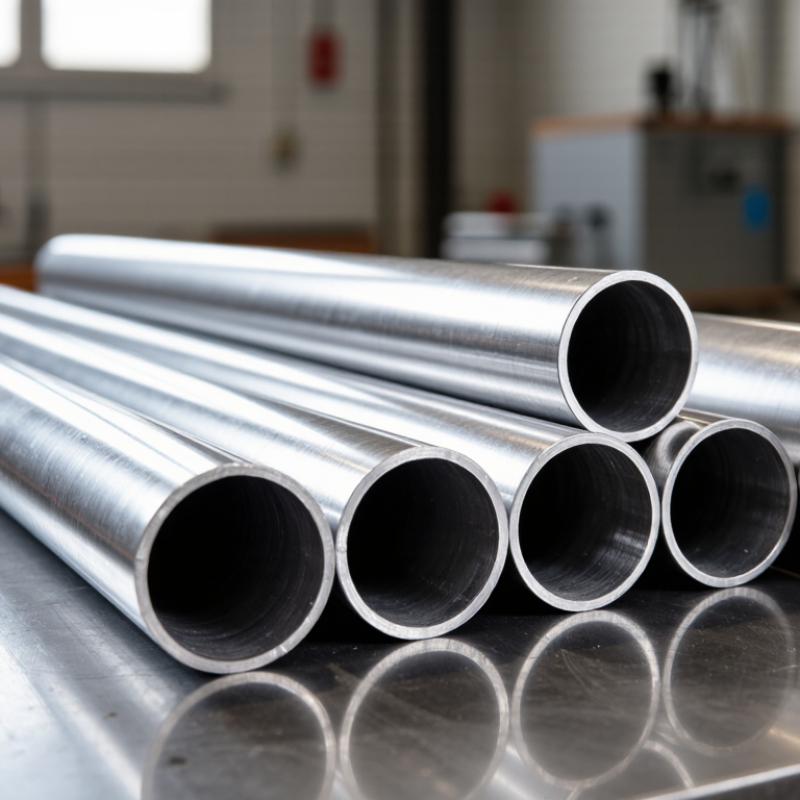
An aluminum round tube is a hollow, cylindrical section with a circular cross-section. Manufacturers usually form it through extrusion, then cut it to specified lengths. Its outside diameter, wall thickness, alloy, and temper determine its performance. A 25 mm tube with a 2 mm wall behaves very differently from a 50 mm tube with the same wall thickness.
Aluminum offers low density, useful corrosion resistance, and straightforward machining. The International Aluminium Institute reported about 70.6 million tonnes of global primary aluminum production in 2023. That scale supports broad material availability, but availability does not guarantee the correct grade. Structural frames may need higher strength, while decorative rails may prioritize surface quality. Welding also changes local strength and can distort thin walls. Small details matter.
Consider the load path, unsupported length, and connection method before choosing a tube. A lightweight section can still buckle under compression. It may also dent during transport. The Aluminum Association notes that aluminum recycling can require roughly 95% less energy than primary production, according to industry lifecycle data. Recycled content can reduce impact, although alloy sorting and surface requirements complicate the calculation. This is where specifications become less tidy. A supplier’s dimensional tolerance, mill certificate, and temper information deserve careful review. The round shape is convenient, not automatically suitable.
| Category | Dimension or Property | Typical Value or Description | Project Benefit |
|---|---|---|---|
| What Is an Aluminum Round Tube? | |||
| Definition | Cross-sectional shape | Hollow circular profile with a continuous outside diameter and an internal bore. | Provides balanced strength and stiffness in multiple directions, making it suitable for frames, supports, guards, rails, and fluid or air passage applications. |
| Common alloys | 6061 and 6063 aluminum | 6061 is commonly selected for higher structural strength; 6063 is widely used for smooth surface finishes and extruded architectural shapes. | Allows the material to be matched to structural, appearance, machining, or fabrication requirements. |
| Basic composition | Aluminum-based alloy | Aluminum alloy with small amounts of elements such as magnesium and silicon, depending on the alloy grade. | Combines low density with useful strength, corrosion resistance, and manufacturing flexibility. |
| Typical Material Properties | |||
| Density | Mass per unit volume | Approximately 2.70 g/cm³ | About one-third the density of steel, which can reduce the weight of assemblies and simplify handling. |
| Thermal conductivity | Heat transfer capability | Approximately 120–235 W/m·K, depending on alloy and temper. | Useful for heat-spreading components, enclosures, heat-transfer structures, and temperature-sensitive assemblies. |
| Electrical conductivity | Material-dependent | Generally higher than that of stainless steel, but the exact value varies with alloy, temper, and condition. | Can be useful for selected electrical, grounding, and conductive structural applications when properly designed. |
| Corrosion behavior | Atmospheric exposure | Forms a thin, adherent oxide layer that helps protect the underlying metal in many environments. | Often suitable for outdoor and humid applications, although aggressive chemicals, saltwater, and galvanic contact still require evaluation. |
| 6061-T6 strength reference | Tensile strength and yield strength | Typical minimum values for wrought 6061-T6 products are about 310 MPa tensile strength and 276 MPa yield strength; tube specifications can vary. | Provides a practical strength-to-weight option for many structural and fabricated components. |
| Melting range | Alloy-dependent | Approximately 580–650°C for many common aluminum alloys. | Supports common cutting, forming, extrusion, and welding processes, while heat effects must be considered during fabrication. |
| Example Round Tube Dimensions | |||
| Example size 1 | Outside diameter × wall thickness | 25 mm × 2 mm | Compact and lightweight option for braces, small frames, handrails, and protective structures. |
| Example size 2 | Outside diameter × wall thickness | 32 mm × 2 mm | Useful where a moderate increase in diameter and stiffness is needed without a large weight increase. |
| Example size 3 | Outside diameter × wall thickness | 40 mm × 3 mm | Suitable for general-purpose frames, supports, equipment structures, and fabricated assemblies. |
| Example size 4 | Outside diameter × wall thickness | 50 mm × 3 mm | Offers greater bending stiffness for larger frames, rails, and support members. |
| Example size 5 | Outside diameter × wall thickness | 60 mm × 4 mm | Appropriate for heavier-duty tubular structures when the design requires a larger section and thicker wall. |
| Theoretical Mass Estimates | |||
| 25 mm × 2 mm tube | Calculated mass per metre | Approximately 0.39 kg/m | Low material mass for portable and lightweight designs. |
| 32 mm × 2 mm tube | Calculated mass per metre | Approximately 0.51 kg/m | Balances moderate stiffness with manageable weight. |
| 40 mm × 3 mm tube | Calculated mass per metre | Approximately 0.94 kg/m | Suitable for stronger general-purpose frameworks. |
| 50 mm × 3 mm tube | Calculated mass per metre | Approximately 1.20 kg/m | Provides increased structural capacity while remaining lighter than a comparable steel tube. |
| 60 mm × 4 mm tube | Calculated mass per metre | Approximately 1.90 kg/m | Offers a larger load-carrying section for heavier tubular structures. |
| Why Choose Aluminum Round Tube? | |||
| Lightweight construction | Low density | Approximately 2.70 g/cm³ compared with roughly 7.85 g/cm³ for carbon steel. | Reduces shipping, lifting, installation, and overall assembly weight. |
| Strength-to-weight efficiency | Section geometry and alloy selection | A round hollow section places material away from the center, improving bending efficiency relative to a solid bar of similar outside diameter. | Can deliver useful stiffness with less material than a solid section. |
| Fabrication | Cutting, drilling, machining, forming, and welding | Can be fabricated using standard metalworking methods; welding may reduce strength in heat-affected areas depending on alloy and temper. | Supports efficient prototyping, repair, and production fabrication. |
| Surface appearance | Finish options | Can be supplied with mill finish and may be anodized, painted, or powder coated when the application requires additional appearance or protection. | Provides design flexibility for visible components and architectural applications. |
| Design consideration | Limitations | Aluminum has a lower elastic modulus than steel, so a similarly sized aluminum tube may deflect more under the same load. | Engineers should check deflection, buckling, fatigue, temperature, connections, and corrosion compatibility before final selection. |
| Calculation note | Theoretical mass formula | Mass per metre ≈ π/4 × (outside diameter² − inside diameter²) × 0.00270, with dimensions in millimetres and mass in kilograms. | Provides a quick estimate; actual mass may vary because of manufacturing tolerances, alloy, temper, and surface treatment. |