- Home
- About Us
- Products
- Customer Cases
- Service
- News
- Blog
- Contact Us
Leave Your Message
Choosing Aluminium Stairs for international projects requires more than comparing prices and polished product photos. Buyers must examine load capacity, tread depth, slip resistance, corrosion protection, installation conditions, and replacement support. A staircase may look elegant in a showroom, yet feel unstable beside a wet pool or busy warehouse.
The International Aluminium Institute reports that around 75% of all aluminium ever produced remains in use today. This supports aluminium’s strong lifecycle value, especially when manufacturers provide traceable alloy information and recycling guidance. The European Aluminium industry also highlights aluminium’s durability, low maintenance needs, and recyclability in building applications. These findings matter for global buyers managing transport, climate exposure, and long-term operating costs.
John Templer, a respected stair-design scholar and author of The Staircase, wrote, “The staircase is an architectural element in its own right.” His point remains useful here. Aluminium Stairs should connect spaces safely, but they can also influence a building’s visual identity. The best models balance engineering, comfort, appearance, and local compliance requirements.
No ranking is perfect.
Some products perform beautifully in dry climates but need stronger coatings near saltwater. Others install quickly but offer limited customization. This guide therefore considers practical evidence, including material quality, testing information, supplier experience, warranty clarity, and user feedback. Readers should still verify regional standards with qualified professionals. A careful final choice often depends on details that product pages fail to show: edge finish, drainage, fixing hardware, and the sound under each step.
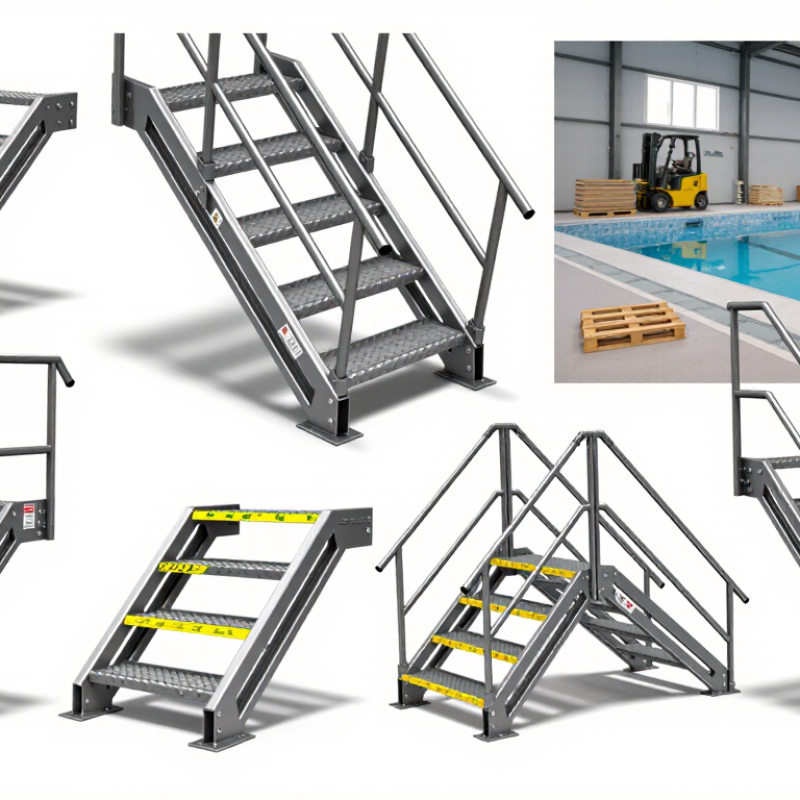
10 Best Aluminium Stairs for Global Buyers
What Makes Aluminium Stairs a Reliable Choice for Global Buyers
Aluminium stairs combine low weight, corrosion resistance, and practical strength. A two-metre unit can be carried through narrow plant corridors without heavy lifting equipment. That matters for warehouses, construction sites, aircraft facilities, and maintenance teams.
The International Aluminium Institute reports that nearly 75% of all aluminium ever produced remains in productive use. Its recycling data also indicates that remelting aluminium requires about 5% of the energy used for primary production. These figures support long service life and stronger circularity claims. However, aluminium is not maintenance-free. Salt, cement dust, and trapped moisture can still damage joints or fittings.
Reliable stairs need more than a bright metal frame. Buyers should verify working-load ratings, platform dimensions, weld quality, anti-slip feet, and corrosion protection. EN 131 and ANSI-ASC A14.2 provide useful safety benchmarks for different markets. A practical inspection should check loose rivets, bent rails, worn feet, and slippery treads. Small defects matter. A lighter stair can also feel less stable on uneven concrete, which is easy to underestimate. Clear instructions, traceable testing documents, and replacement parts reduce that risk. The safest choice is not always the cheapest shipment. It is the model that remains stable, repairable, and compliant after repeated use.
| Rank | Aluminium Stair Type | Typical Application | Common Configuration | Typical Platform or Reach Height | Typical Rated Load | Approx. Product Weight | Key Reliability Features | Common Reference Standard |
|---|---|---|---|---|---|---|---|---|
| 1 | Single-Sided Step Ladder | Indoor maintenance, stockroom access and light commercial work | 5–10 steps with a top standing platform | 1.2–2.4 m platform height | 120–150 kg | 4–10 kg | Non-slip feet, wide treads, lightweight corrosion-resistant frame and locking spreaders | EN 131 or ANSI-ASC A14.2, depending on the destination market |
| 2 | Double-Sided A-Frame Ladder | Warehouses, retail facilities and construction finishing work | 6–14 steps on both sides | 1.5–3.4 m standing height | 120–150 kg | 6–18 kg | Two-sided access, reinforced hinges, anti-slip feet and stable cross-bracing | EN 131 or ANSI-ASC A14.2 |
| 3 | Platform Step Ladder | Electrical, mechanical and industrial service tasks requiring extended standing | Large top platform with guardrail and handrail | 0.9–2.1 m platform height | 120–150 kg | 7–20 kg | Guardrail protection, slip-resistant platform, heavy-duty steps and high stability | EN 131; additional workplace rules may apply |
| 4 | Extension Ladder | Building exteriors, roof access, utility work and high-level maintenance | Two- or three-section telescoping design | 4.0–11.0 m maximum length | 120–150 kg | 10–35 kg | Automatic rung locks, guide brackets, stabilising feet and strong extruded rails | EN 131 or ANSI-ASC A14.2 |
| 5 | Telescopic Aluminium Ladder | Service vehicles, compact storage areas and mobile technicians | Collapsible multi-section ladder | 2.6–4.8 m maximum length | 100–150 kg | 8–18 kg | Compact transport size, individually locking rungs, rubber feet and low maintenance | EN 131 where the specific model is certified |
| 6 | Mobile Warehouse Stair | Picking, inventory control and access to shelving or mezzanines | Fixed incline steps with handrails and casters | 0.8–3.0 m platform height | 150–250 kg | 25–80 kg | Locking swivel casters, wide treads, handrails and a broad anti-tip base | Applicable local industrial-access and workplace-safety regulations |
| 7 | Aircraft and Vehicle Access Stairs | Aircraft cabins, buses, trucks, trailers and elevated vehicle platforms | Fixed or mobile stairway with access platform | 1.0–4.0 m platform height | 150–300 kg | 35–120 kg | High-grip steps, twin handrails, locking wheels and corrosion-resistant construction | Project-specific transport, aviation or workplace requirements |
| 8 | Folding Attic and Loft Stair | Residential and commercial roof-space access | Folding or sliding ladder with insulated hatch frame | 2.4–3.2 m floor-to-floor height | 150–200 kg | 12–30 kg | Space-saving mechanism, reinforced hinges, slip-resistant treads and adjustable feet | Building-code requirements vary by country and installation type |
| 9 | Pool and Marine Boarding Ladder | Swimming pools, docks, pontoons and small marine craft | Fixed or removable ladder with curved handrails | 0.6–1.5 m access height | 100–150 kg | 3–15 kg | Marine-grade fasteners, rounded edges, slip-resistant steps and strong resistance to moisture | Application-specific pool or marine safety requirements |
| 10 | Industrial Crossover Stair | Factories, processing lines, conveyors and equipment platforms | Permanent stair with elevated crossover platform | 1.0–4.5 m platform height | 250–500 kg distributed load | 60–220 kg | Guardrails, toe boards, deep treads, welded joints and high structural rigidity | EN ISO 14122 or equivalent local machinery-access requirements |
| Reference values are typical market ranges for aluminium stair and ladder categories, not guaranteed specifications for every model. Buyers should confirm alloy grade, dimensions, load rating, certification, packaging and installation requirements with the manufacturer before purchase. | ||||||||